
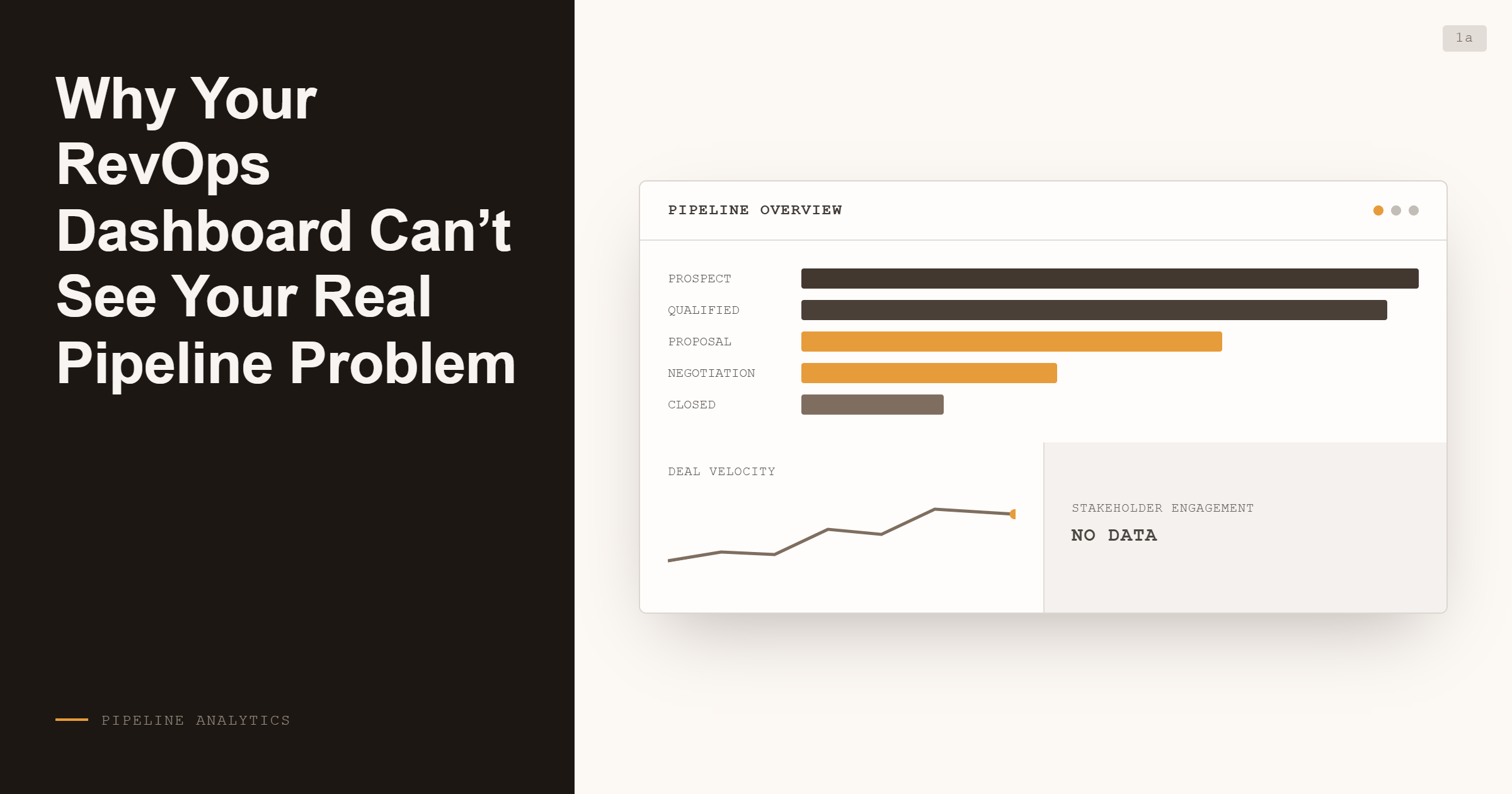
Your CRM is full. Your dashboards update in real time. Your reps are hitting their call and demo quotas. And your pipeline is still leaking revenue you can’t explain.
If you’re a CRO or a RevOps leader, you already know this feeling. You can see every stage, every touch, every open rate. What you can’t see is why a deal that looked healthy on Tuesday goes cold by Friday, or why a lead who filled out your form ghosts after the first call.
Here’s the uncomfortable truth. The problem isn’t happening in your funnel. It’s happening before your funnel even starts, in a part of the B2B buyer journey your revenue operations tools were never built to track.
Your RevOps dashboard can’t see your real pipeline problem because most of the modern buyer journey now happens outside any system you own, in search engines, AI answer engines, peer communities, and review sites, before a prospect ever fills out a form or books a call. Dashboards are built to measure activity inside your CRM. They were never designed to measure trust and visibility built before that activity starts.
The 17% Problem
For years, sales and marketing teams built their entire go-to-market motion around the idea that buyers move through a funnel you control: awareness, interest, consideration, decision, all trackable, all attributable.
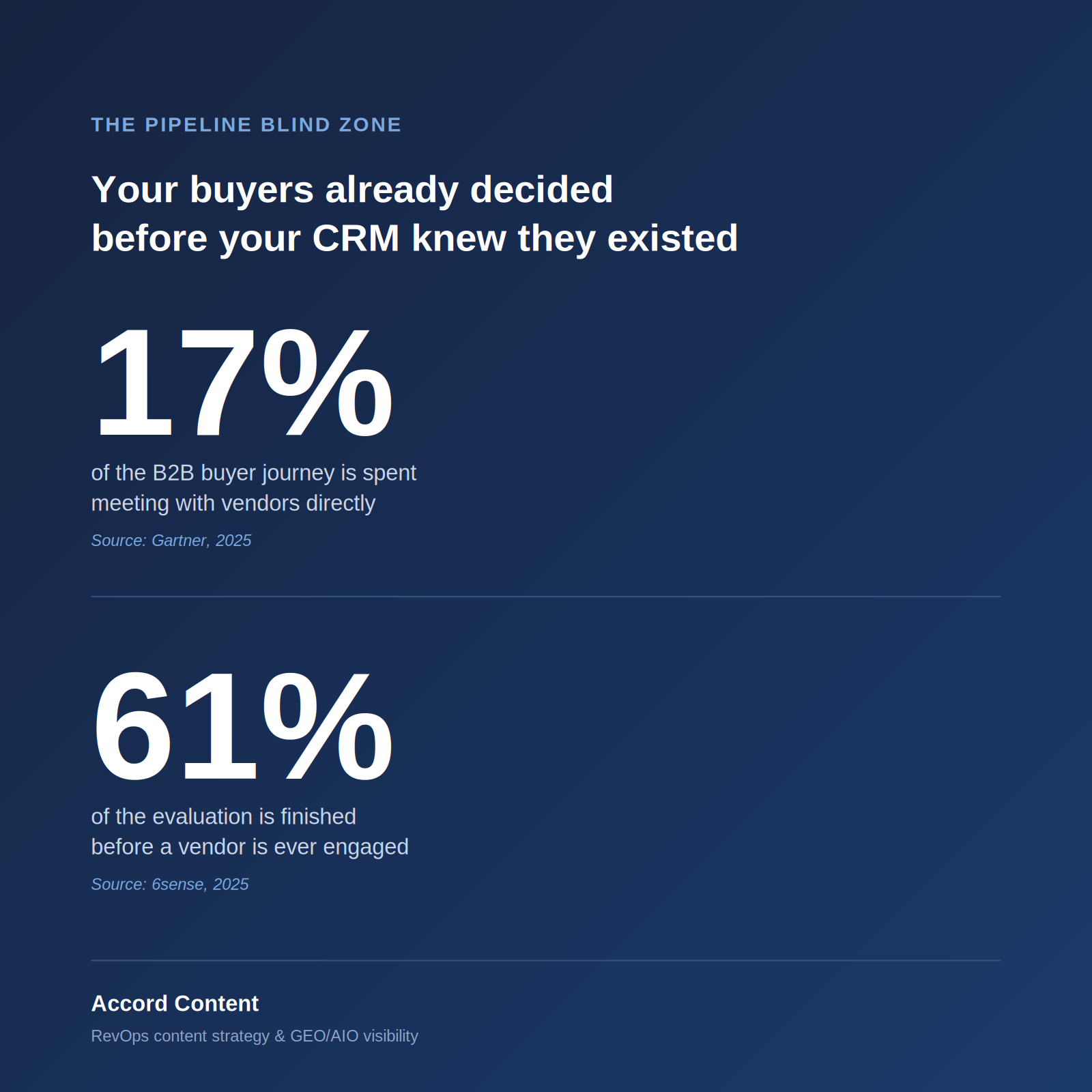
That model is broken, and the data backs it up. Gartner’s research on the B2B buyer journey found that buyers now spend only about 17% of their total purchase journey actually meeting with potential suppliers, and when comparing multiple vendors, that drops to just 5 to 6% of time spent with any single rep. Separate 2025 research from 6sense on B2B buying behavior found that buyers complete roughly 61% of their evaluation before they ever engage a vendor directly, and by the time a deal reaches day one of your tracked pipeline, about four out of five vendors on the buyer’s shortlist are already decided, with the eventual winner already on that list 95% of the time.
Read that again. The decision is mostly made before your CRM logs the first activity.
Add to that the complexity of who’s actually buying. Gartner has also found that a typical B2B buying group now includes 6 to 10 decision makers, each showing up with 4 to 5 pieces of research they gathered entirely on their own, through search, peer conversations, review sites, and increasingly, AI tools. They’re not moving through your funnel in a straight line. They’re looping back, comparing notes, and forming opinions in places you have zero visibility into.
Your dashboard shows you what happens after a buyer raises their hand. It was never built to show you what happens before.
Meet the Pipeline Blind Zone
There’s a name worth giving this: the Pipeline Blind Zone. It’s the stretch of the buyer journey where the prospect is actively researching, forming opinions, and narrowing their shortlist, all while producing zero trackable activity in your RevOps stack.
This is different from what people sometimes call the “dark funnel,” which usually refers to untracked marketing touches. The Pipeline Blind Zone is bigger than that. It includes:
- Google and AI-assisted research done before your brand is ever searched by name
- Peer recommendations in private Slack groups, forums, and DMs
- Competitor comparisons happening on review sites you don’t control
- Internal buying-committee debates you’re not in the room for
- AI tools like ChatGPT, Perplexity, or Gemini being asked to summarize or recommend vendors in your category
None of this shows up as a lead source. All of it shapes whether your company makes the shortlist.
Why This Is a RevOps Problem, Not Just a Marketing One
It’s tempting to file this under “marketing’s job.” It isn’t, and treating it that way is exactly why the Blind Zone keeps costing you pipeline.
RevOps exists to align the entire revenue engine, and an engine that only measures what happens after the buyer shows up is measuring the wrong half of the process. Consider what the Blind Zone actually does to your numbers:
It inflates your CAC without explanation. If buyers are quietly ruling you out during their independent research phase, you’re paying for ads, SDR hours, and outbound sequences to reach people who already decided against you before the first touch registered in your CRM.
It distorts your attribution model entirely. Standard sales research shows that 71% of B2B buyers already had a vendor preference before their first tracked website session. If your attribution model credits the demo request as the starting point, you’re crediting the wrong moment and optimizing the wrong channel.
It hides why deals stall in “interested.” A prospect who enters your pipeline without having formed real trust in your brand during their research phase is a prospect who was never fully sold in the first place. The stall isn’t a sales execution problem. It’s a trust deficit your funnel data can’t diagnose because it never measured trust to begin with.
It makes your sales cycle longer than it needs to be. Reps end up doing education and trust-building work manually, on calls, that should have already happened before the prospect ever booked time. That’s expensive selling time spent re-explaining what content should have already answered.
This isn’t a fringe theory. PartnerStack’s 2026 breakdown of how RevOps teams measure AI search attribution makes the point directly: traditional pipeline reporting was built around clicks and sessions, but AI-driven discovery now happens before either one exists, which means the signals that actually matter arrive indirect, delayed, and easy to misread. Their research splits this into two separate problems RevOps teams tend to conflate: whether AI visibility is happening at all, and whether that visibility is actually converting into revenue. Most teams are missing both, which is exactly why sales pipeline attribution keeps producing numbers that don’t add up.
What Your Dashboard Would Need to See
To close the Blind Zone and restore real pipeline visibility, RevOps needs a different kind of measurement, one that doesn’t come from more CRM fields or another attribution tool. It comes from having a presence in the moments buyers are actually researching, before they ever touch your funnel. This is the discipline now commonly called generative engine optimization, or GEO, and it sits alongside AI answer engine optimization, or AEO, as the newer half of a modern content strategy for RevOps teams.
That means showing up in:
- The search results buyers hit when they’re still defining the problem, not just when they’re comparing named vendors
- The AI-generated answers tools like ChatGPT and Perplexity give when a buyer asks “what’s the best solution for X,” since a growing share of buyers now use AI directly during their purchase process
- The comparison and review content buyers read when narrowing a shortlist
- The peer conversations and communities where your category gets discussed honestly
This is not a traffic problem. It’s a trust and visibility problem, and it’s one that has to be solved before a prospect ever reaches a stage your dashboard can measure.
The shift is already reshaping how search itself works. Adobe’s 2026 report on AI and search puts it plainly: by 2026, visibility depends less on page position and more on whether a brand gets cited inside AI-generated responses at all, and earning those citations requires content that’s clear, well structured, and easy for AI systems to verify. That’s a direct shift away from ranking for keywords and toward being the source AI systems trust enough to reference.
It’s also measurable, even before it shows up as direct traffic. AirOps research on AI visibility metrics in 2026 found that brands earning both citations and mentions in AI answers are 40% more likely to resurface across multiple AI-generated responses than brands that only get cited once. In other words, consistent visibility compounds. A single mention barely moves the needle. Being the source AI systems keep coming back to is what actually closes the Blind Zone.
That’s the piece most RevOps stacks are missing, and it’s also the piece that a real content strategy, built with intent rather than a content calendar full of generic blog posts, is actually built to solve. We’ll get into exactly what that looks like in the next part of this series.
A Real Example: How Gong Closed Its Own Blind Zone
Gong, the revenue intelligence platform, is one of the clearest examples of a company that built its entire growth engine around showing up during the research phase instead of waiting for buyers to reach out.
Early on, Gong turned what was meant to be a gated ebook into fully public articles, betting that visibility in front of sales leaders mattered more than capturing a form fill. The person driving that call had a sales background himself, which shaped a content strategy built around data-backed insights that sales leaders could actually use, not generic thought leadership.
That approach compounded. According to an analysis of Gong’s content strategy, the company now ranks for more than 200 keywords tied to adjacent categories like sales coaching and call recording software, not just its core product category, making sure it shows up no matter how a buyer frames the problem in their own research.
Gong applied the same logic to distribution. Per LinkedIn’s own case study on the company, its marketing team deliberately built out its LinkedIn presence to put content in front of more buyers earlier, leaning into short, high-value video. The first video in that new format alone pulled in more than 17,000 views and 250 comments, and the page’s overall following grew 85% in a single month.
None of that activity would show up as a lead source in a standard RevOps dashboard. It happened entirely in the research phase, the same Blind Zone most CROs can’t see into. Gong simply made sure it was the thing buyers found while they were there.
The Bottom Line
Your funnel metrics aren’t lying to you. They’re just incomplete. The real pipeline problem for most CROs and RevOps leaders right now isn’t happening at the stages you can measure. It’s happening in the Blind Zone before the buyer ever shows up, and no amount of dashboard optimization will fix a gap your tools were never designed to see.
If your numbers feel off and you can’t pinpoint why, stop looking deeper into the funnel. Start looking earlier than the funnel.
Frequently Asked Questions
What is the Pipeline Blind Zone?
The Pipeline Blind Zone is the part of the B2B buyer journey where a prospect is researching, forming opinions, and narrowing a shortlist, but produces no trackable activity in a company’s CRM or RevOps stack. It happens before a lead is ever captured.
Why can’t RevOps dashboards see this stage of the buyer journey?
RevOps tools are built to track activity that happens inside owned systems, like form fills, email opens, and call logs. Buyer research done through search, AI tools, peer conversations, and review sites happens outside those systems entirely, so it never gets recorded.
How much of the B2B buying journey happens before sales contact?
Research varies by source, but the direction is consistent. Gartner has found buyers spend as little as 17% of their total purchase journey meeting with vendors, while 6sense has found buyers complete roughly 61% of their evaluation before engaging a vendor at all.
Is this a marketing problem or a RevOps problem?
Both. Marketing owns much of the content that fills the gap, but RevOps owns the metrics, attribution, and revenue outcomes the Blind Zone distorts. Treating it as purely a marketing issue is why the gap keeps getting missed.
What fixes the Blind Zone?
Consistent visibility in the places buyers actually research, including search engines, AI answer engines like ChatGPT and Perplexity, review sites, and peer communities, built through a deliberate content strategy rather than occasional blog posts.